
If you are seeing this page right now, you are probably searching for something. Maybe you are searching for information about AI and the future of humanity, technology, or what the world may look like in the coming years. But what if the technology we created eventually changes the way humans live and work?
If you are searching for insights into AI and the future of humanity, you are witnessing a major turning point in history. Every historical breakthrough opened the door to another innovation, leading directly into the modern age of artificial intelligence. But this time, something is fundamentally different: humans are no longer just building machines for physical toil; we are creating systems that can execute complex cognitive tasks.
AI models can process massive amounts of information, adapt to new patterns, and perform high-level intellectual labor in seconds. Paired with emerging humanoid robotics, machines may soon handle both physical and cognitive labor. According to research on the global workforce by the World Economic Forum, rapid automation will reshape modern employment markets well before new economic balances stabilize. You can also explore our latest technology analyses to see how automation is already altering everyday work tools.
AI and the Future of Humanity:
Consider an everyday professional named Aman. Aman has a wife and two children. Both Aman and his wife work steady jobs. They earn a living, buy food, pay school fees, purchase clothes, travel, and occasionally upgrade their home electronics.
When a new smartphone launches, Aman purchases two units for his household. The phone company earns money, the retail store earns a margin, and the employees receive wages. Those employees then spend their earnings across other parts of the market.
The economic cycle continues smoothly:
-
People work and earn wages.
-
Families spend their disposable income.
-
Businesses generate revenue and hire teams.
-
The broader economy remains active.
Now imagine what happens when advanced automation enters that equation. An employer discovers that automated systems and robotic units can complete the tasks previously handled by Aman and thousands of other employees. Aman loses his job, and his wife faces the same challenge.
When the next smartphone hits the market, Aman wants to buy it, but he cannot. Not because the product is unavailable, but because his household no longer has an income. If millions of households face identical displacement, factories may run at maximum efficiency and make products cheaper, but consumer demand collapses.
(Insert your humanoid robot image here with the alt text: AI and the future of humanity with a humanoid robot)
The Real Problem: AI and the Future of Humanity’s Economy
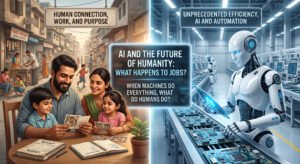
Discussions often stop at the simple question: “Will robots take our jobs?”
A much more critical question lies underneath: “If automated systems replace human earners, who buys the products?”
This is an economic and social crisis, not just a technological challenge. When people stop earning, they reduce their spending. They postpone purchasing homes, vehicles, gadgets, and services. For deeper context on how these shifts unfold across industries, read our guide on automation and labor markets.
Businesses could soon face an unprecedented paradox: the ability to produce unlimited goods, but an economy where fewer people have the money to buy them.
Should We Stop AI Development?
Halting technological progress is neither practical nor desirable. Advanced machine learning drives life-saving medical discoveries, optimizes agricultural yields, accelerates scientific research, and shields human workers from dangerous environments.
The central question is not whether we should stop AI, but rather: How much autonomy do we delegate to automated systems, where should boundaries remain firm, and how do we ensure humans continue to benefit from productivity gains?
Powerful tools demand clear regulatory guardrails and conscious human oversight.
Humans vs Machines
A humanoid robot can emulate conversational patterns, process datasets rapidly, and perform physical movements with high precision. It may even learn skills that take a person years to master.
Yet functional efficiency does not make a machine human.
Human experience is built on families, shared memories, empathy, emotional depth, and moral purpose. Technological progress should not be framed as an adversarial conflict between biological workers and synthetic systems; it must center on keeping human agency and well-being at the core of technological adoption.
The Future Remains in Our Hands
Human beings design software architectures, construct hardware, and legislate market rules. Technology does not govern its own trajectory—people do.
If automation eventually achieves unprecedented productive capacity, economic structures will need to adapt so that broad populations share in that wealth. The defining test of the current era is not whether machines can match human intellect, but what roles, protections, and purposes humanity will secure when machines handle routine labor.